
Too Deep A Dive - Volume 4 - Heatwave
Heatwave: The Rise, Reign, and Rhythm of a Funk Phenomenon

Heatwave: History and Legacy
Introduction
Heatwave is a British–American funk and disco band formed in London in 1975, best known for a string of 1970s hits that blended slick funk grooves with soulful R&B. The multinational group – which included Americans Johnnie Wilder Jr. and Keith Wilder on vocals, English songwriter Rod Temperton on keyboards, and other members from Europe and the Caribbean – became famous for dancefloor anthems like “Boogie Nights” and romantic slow jams like “Always and Forever.” They achieved major chart success on both sides of the Atlantic during the late 1970s . This report provides an in-depth look at Heatwave’s formation, evolution, key members, discography, hit songs, influence on music, collaborations with notable artists, and the band’s legacy, including post-peak activities and fascinating anecdotes.
Formation and Early Years (1975–1976)
Heatwave’s story begins with Johnnie Wilder Jr., an American serviceman from Dayton, Ohio who was stationed in West Germany in the early 1970s. While in the U.S. Army, Wilder sang in clubs and bars during his off-duty time. After his discharge, he decided to stay in Europe and eventually moved to the UK. In London, Johnnie placed an ad in a music publication seeking fellow musicians; one of the respondents was Rod Temperton, a talented English keyboardist and songwriter . Together they formed a band initially billed as Johnnie Wilder’s Chicago Heatwave, named partly because their early guitarist, Jesse Whitten, was from Chicago. Johnnie soon invited his brother Keith Wilder (who had been singing in bands back in Ohio) to join as co-vocalist, creating a powerful vocal duo.
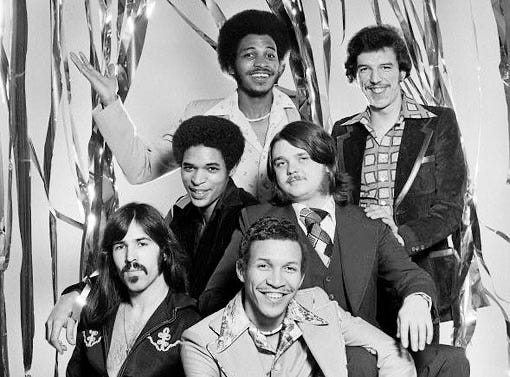
By 1975, the group had coalesced into a truly international lineup. In addition to the Wilder brothers (Johnnie and Keith) and Rod Temperton, the classic early lineup featured Mario Mantese from Switzerland on bass, Ernest “Bilbo” Berger from the former Czechoslovakia on drums, and Eric Johns from Jamaica on guitar. This eclectic mix of nationalities and musical backgrounds helped shape Heatwave’s distinctive sound – a blend of American funk and soul with a cosmopolitan disco flair. The band honed their act touring the London club circuit and U.S. military bases in Europe, developing tight musicianship and a crowd-pleasing stage show. Their hard work paid off when they landed a record deal with the UK label GTO Records in 1976 (with Epic Records handling U.S. distribution). GTO paired Heatwave with producer Barry Blue, and the group entered the studio in late 1976 to record their debut album.
Breakthrough Success (1977–1978)
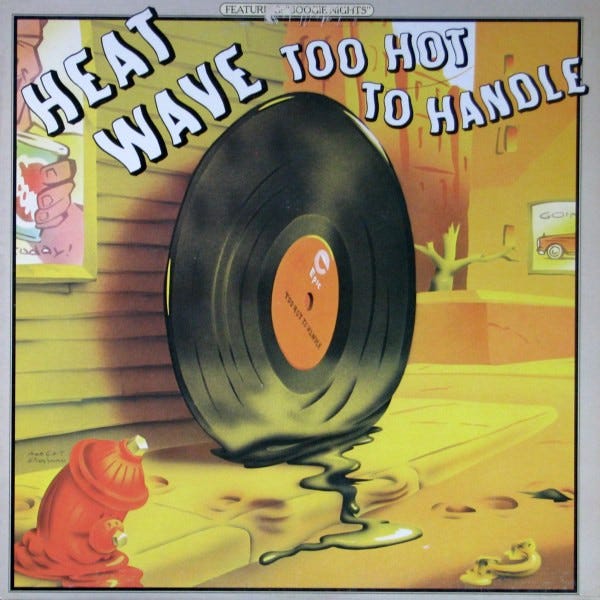
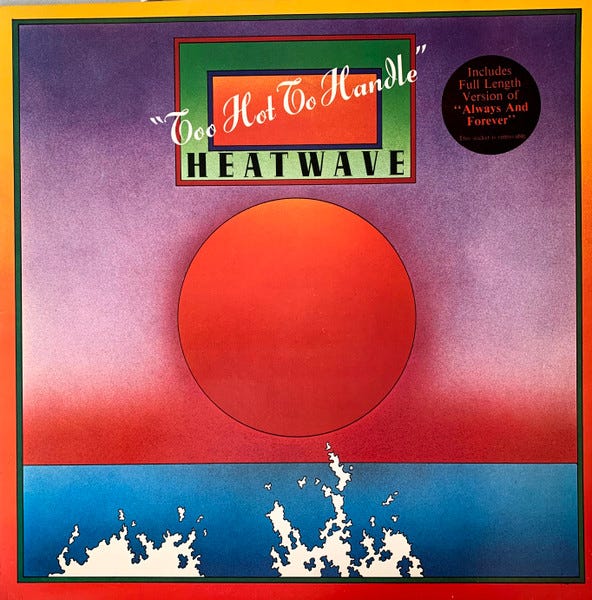
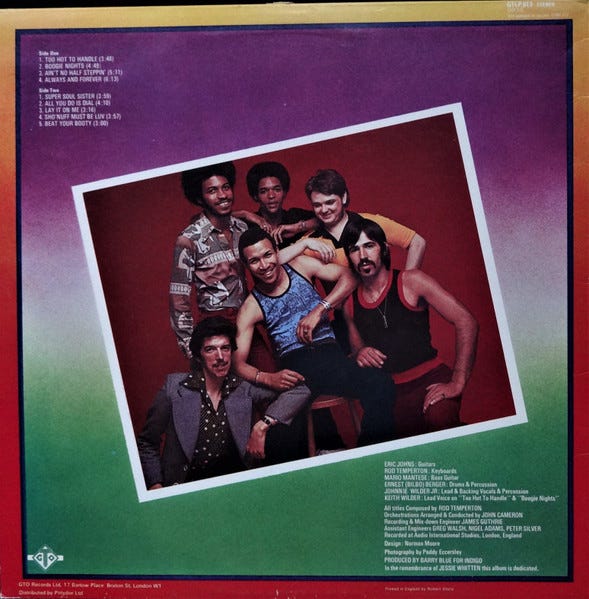
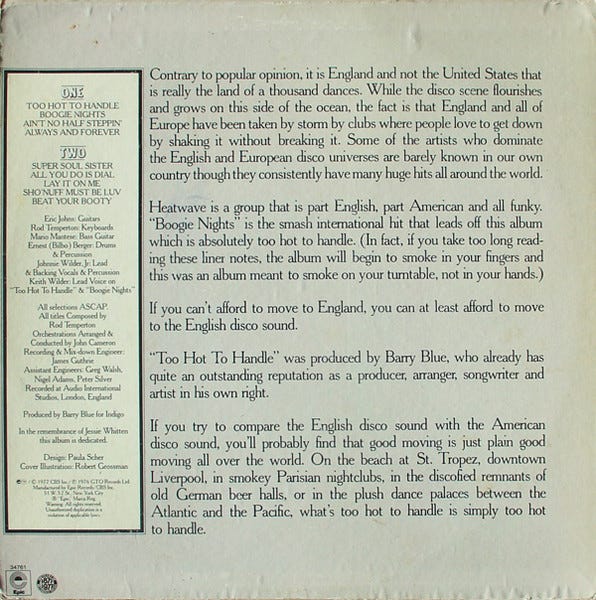
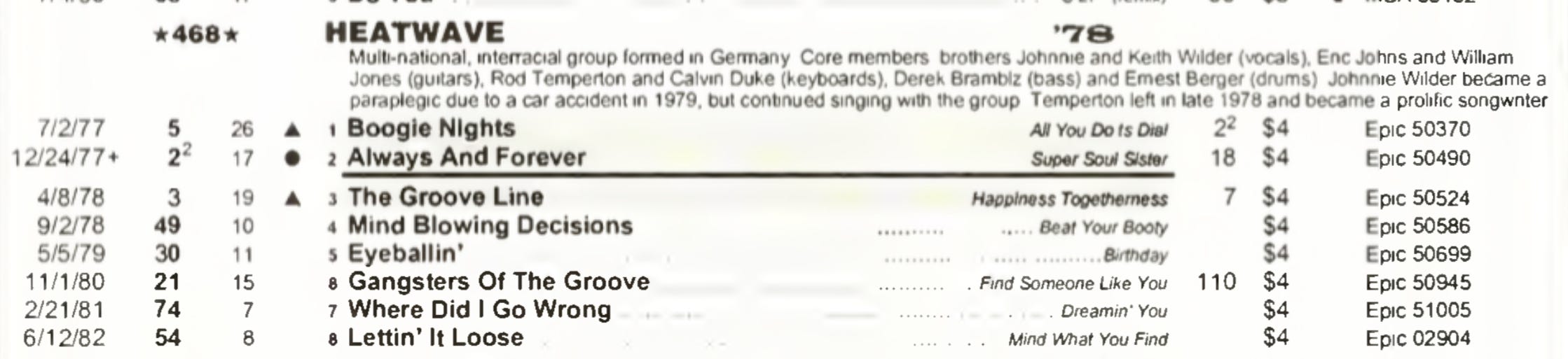
Heatwave’s debut album Too Hot to Handle (1976 UK / 1977 US) gave the band its first major hits. The band’s first album Too Hot to Handle was released in June 1976 in the UK and in May 1977 in the U.S.. It quickly established Heatwave as rising stars of the disco-funk era. After a couple of minor initial singles, Heatwave scored a massive breakthrough with “Boogie Nights,” the third single from the album. Written by Rod Temperton, “Boogie Nights” is a propulsive dance track with a catchy groove and festive party vibe. The song rocketed up the charts on both sides of the Atlantic – in early 1977 it hit No. 2 on the UK Singles Chart, and later that year it reached No. 2 on the U.S. Billboard Hot 100 (held off the top spot only by Debby Boone’s “You Light Up My Life”). “Boogie Nights” was certified Platinum and became an enduring disco anthem, helping Too Hot to Handle climb to No. 11 on the Billboard 200 albums chart and No. 5 on the R&B album chart in the U.S.. The album eventually earned Platinum certification in America and Silver in the UK. Alongside “Boogie Nights,” the album produced other funk tracks like the James Brown-influenced “Ain’t No Half Steppin’,” but it also showcased Heatwave’s range with a soon-to-be classic ballad.
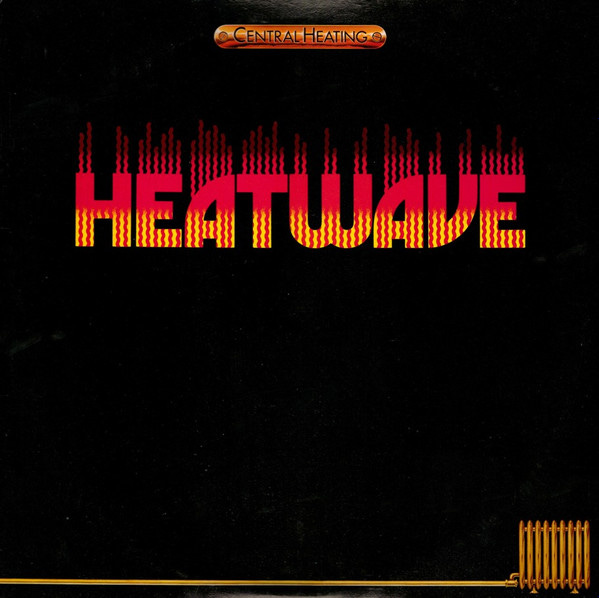
Heatwave’s second album Central Heating (1978), continued the band’s run of hits. In late 1977, Heatwave released “Always and Forever,” a soulful slow jam from the debut album that became one of their signature songs. Sung with heartfelt intensity by Johnnie Wilder Jr., “Always and Forever” reached No. 18 on the U.S. pop chart in March 1978 and was a No. 2 hit on Billboard’s R&B chart – the band’s highest-ever R&B showing. In the UK, it was issued as a double A-side (paired with the mid-tempo groover “Mind Blowing Decisions”) and peaked at No. 9, giving Heatwave a second UK Top 10 hit. The song, written by Temperton, has since become an R&B standard covered by numerous artists and a popular choice for weddings and proms, thanks to its romantic lyrics and smooth melody. Buoyed by these hits, Heatwave quickly followed up with a sophomore album. Central Heating, produced again by Barry Blue, came out in April 1978 (late 1977 in the UK). It continued the band’s hot streak: the lead single “The Groove Line” was another upbeat dance-funk smash that reached No. 7 on the U.S. Hot 100 in mid-1978 and No. 12 in the UK . “The Groove Line” earned a Platinum certification and remains a classic of the disco era, celebrated for its funky bassline and catchy hook about getting “down, down” on the dance floor . Central Heating also contained the quiet-storm favorite “Mind Blowing Decisions,” which, while not released as a single in the U.S., became a UK hit (No. 12) and showcased the band’s softer, harmony-rich side . By the late 1978, Heatwave had firmly established themselves internationally with two hit albums and a reputation for both infectious dance tracks and soulful ballads.
Key Members and Lineup Changes
Heatwave’s lineup saw several changes over the years, especially after their initial burst of success. Below are brief biographies of the key members and notes on the band’s evolving roster:
Johnnie Wilder Jr. (Lead Vocals) – The co-founder and co-lead singer of Heatwave, Johnnie was the soulful voice at the core of the band’s sound. Born in 1949 in Dayton, Ohio, he served in Vietnam and Germany before starting Heatwave in London. Johnnie’s dynamic stage presence (including choreographed dance moves) and gospel-honed vocals powered hits like “Boogie Nights” and “Always and Forever.” Tragically, at the height of Heatwave’s fame, Johnnie was in a car accident in February 1979 while visiting family in Dayton. He survived but was paralyzed from the neck down, which ended his ability to perform live. Remarkably, Johnnie continued to contribute to Heatwave in the studio – providing vocals and co-producing recordings despite his disability. He later devoted himself to inspirational gospel music, recording a cappella gospel albums in the 1980s and 90s, and remained a guiding figure for the band until he passed away in 2006.
Keith Wilder (Lead Vocals) – Johnnie’s younger brother (born 1951), Keith joined Heatwave in 1976 to add vocal strength. His gritty tenor vocals traded leads and harmonies with Johnnie, as heard on tracks like “Super Soul Sister” and “The Groove Line.” After Johnnie’s accident, Keith became the frontman for Heatwave on stage, keeping the group’s live performances alive through the 1980s . He led various reincarnations of Heatwave in later years, touring the UK, Europe, and beyond well into the 1990s . Keith was the longest-running member of the band, appearing on all Heatwave studio albums. He died in October 2017 at age 65, shortly after the band’s induction into the Rhythm & Blues Music Hall of Fame (2017) .
Rod Temperton (Keyboards & Songwriting) – A native of Cleethorpes, England, Rod Temperton was the creative songwriting genius behind Heatwave’s biggest hits. He penned every song on their debut album and the majority of tracks on subsequent albums . Temperton’s diverse writing ranged from high-energy funk (“Boogie Nights”) to tender ballads (“Always and Forever”). In mid-1978, after two albums with Heatwave, Rod left the band’s lineup to become a full-time songwriter (though he continued writing new material for Heatwave through 1982 ). He soon gained renown for writing mega-hits for other artists. Notably, Temperton wrote songs for Rufus & Chaka Khan, The Brothers Johnson, George Benson, Herbie Hancock, and Quincy Jones . Most famously, he joined forces with producer Quincy Jones to write three songs on Michael Jackson’s Off the Wall (1979) and three more on Thriller (1982) – including the iconic title tracks of both albums . This astonishing second career earned Temperton the nickname “The Invisible Man” in the music industry. He remained a behind-the-scenes hitmaker through the 1980s and 90s. Rod Temperton passed away in 2016 at age 66 after a battle with cancer , leaving behind a legacy as one of pop and R&B’s great songwriters.
Mario Mantese (Bass) – A Swiss bassist, Mario (“Marco”) Mantese was part of Heatwave’s core 1970s lineup and contributed funky basslines on the first two albums. In a shocking incident in 1978, Mario was stabbed in the heart by his girlfriend during an argument, after attending a party at Elton John’s house . He was clinically dead for several minutes and then fell into a coma. When he awoke months later, he was left blind, mute, and paralyzed . Amazingly, Mantese eventually recovered his sight and speech after intensive therapy, though he never rejoined Heatwave as a performer . He chose not to press charges and even reconciled with the girlfriend who wounded him . Mario’s slot in the band was filled by another bassist in 1978, but his story is one of survival and forgiveness. In later years, Mario Mantese became a spiritual author and teacher, writing books about his near-death experience and recovery . As of 2024, he is the sole surviving member of Heatwave’s original lineup .
Ernest “Bilbo” Berger (Drums) – Heatwave’s original drummer, Ernest Berger hailed from Czechoslovakia and provided the steady beat on the band’s classic tracks. His solid grooves anchored songs from “Boogie Nights” to “The Groove Line.” Berger remained with Heatwave through the early 1980s and even returned for some reunion shows in the 1990s . After decades out of the spotlight, Ernest “Bilbo” Berger passed away from a heart attack in March 2024 at age 73 .
Eric Johns (Guitar) – A Jamaican guitarist, Eric Johns was part of Heatwave’s founding lineup and played lead guitar on Too Hot to Handle and early hits. He left the band in the late 1970s (around 1977) after the first album . Eric’s departure led to guitarist Roy Carter joining Heatwave.
Roy Carter (Guitar) – Roy Carter, from London, joined Heatwave in 1977 to replace the late Jesse Whitten on rhythm guitar . He became a full member by the second album, contributing guitar and even some songwriting. Carter stayed with Heatwave through the late ’70s and early ’80s, leaving by 1982 to pursue a career in production . (Earlier, in 1976, Jesse Whitten, who had been an original member, was tragically stabbed to death before the band recorded its first album, necessitating Roy Carter’s role).
Derek Bramble (Bass) – After Mario Mantese’s incapacitation in 1978, British bassist Derek Bramble stepped in on bass. Bramble played on the later albums Hot Property and Candles. He remained until 1982, when he left to become a producer . Derek Bramble went on to work in studio production for artists like David Bowie (on 1984’s Tonight album) and soul singer Jaki Graham .
Calvin Duke (Keyboards) – Brought in around 1978 after Rod Temperton stopped touring with the band, Calvin Duke augmented Heatwave on keyboards from the Hot Property era onward . His addition helped fill Temperton’s role on stage, though Temperton still wrote songs behind the scenes.
James “J.D.” Nicholas (Vocals) – J.D. Nicholas (from London) was recruited in 1980 to handle co-lead vocals after Johnnie Wilder could no longer tour . Nicholas’s voice can be heard on the Candles album. He provided strong vocals, though he “was not nearly the dancer that Wilder was,” and thus the band’s live shows became less dance-focused without Johnnie . J.D. Nicholas left Heatwave in 1982 and achieved greater fame when he joined the Commodores in 1984, replacing Lionel Richie as that group’s lead singer . He continued to perform with the Commodores in subsequent decades.
Other musicians associated with Heatwave include Billy Jones (who replaced Eric Johns on guitar in the late ’70s and later returned for the 1988 reunion album), and various members who joined in later revival lineups (such as keyboardist Byron Byrd and bassist Dave Williamson in the 1990s) . However, the members listed above represent the core contributors during Heatwave’s peak years and immediately thereafter.
Discography
Heatwave’s official discography includes five studio albums from their classic era, one later studio album, and numerous compilation albums. Below is a summary of their studio albums with release dates, chart positions, and notable details:
Too Hot to Handle (1976 UK / 1977 US) – Debut album on GTO/Epic, produced by Barry Blue. Peaked at No. 11 on the U.S. Billboard 200 and No. 5 on the Billboard R&B Albums chart ; reached No. 46 in the UK . This album went Platinum in the US and Silver in the UK . Too Hot to Handle introduced Heatwave’s sound and yielded hit singles “Boogie Nights” (No. 2 US, No. 2 UK) and “Always and Forever” (No. 18 US, No. 9 UK) . Other singles included “Ain’t No Half Steppin’” and the title track, which had more modest chart success. Notably, every song on this album was written by Rod Temperton , showcasing his songwriting prowess. (Fun fact: Temperton’s song “Turn Out the Lamplight,” recorded during these sessions, was later recorded by George Benson on his Quincy Jones-produced album Give Me the Night .)


Central Heating (1978) – Second album (released late 1977 in UK, spring 1978 in US). Peaked at No. 10 on the U.S. Billboard 200 and No. 2 on U.S. R&B Albums ; hit No. 26 on the UK Albums chart . Also certified Platinum in the US . Central Heating continued Heatwave’s momentum with the hits “The Groove Line” (No. 7 US, No. 12 UK) and “Mind Blowing Decisions” (No. 12 UK) . This album was the last to feature bassist Mario Mantese and guitarist Eric Johns (who left during its making), and the first to include new guitarist Roy Carter . It was also Rod Temperton’s final album as an active Heatwave member, though he kept writing for the band afterward . The album track “Star of a Story” from Central Heating would later be covered by George Benson as well .


Hot Property (1979) – Third studio album, released in May 1979 . Produced by renowned engineer/producer Phil Ramone, this album marked a period of transition. Hot Property reached No. 38 on the U.S. album chart and No. 16 on the R&B chart , a drop from their earlier heights, though it was certified Gold in the U.S. . Notable songs include “Razzle Dazzle” (a minor UK hit at No. 43) and “Eyeballin’” (which hit No. 30 on the U.S. R&B chart) . By this album, Rod Temperton was strictly the songwriter (no longer touring), and new members like bassist Derek Bramble and keyboardist Calvin Duke were in the lineup. Hot Property has a slightly different flavor due to Phil Ramone’s production and the band’s adjustments after the turbulence of 1978.


Candles (1980) – Fourth album, released November 1980 . Candles peaked at No. 71 on the U.S. Billboard 200 and No. 24 on the U.S. R&B chart ; in the UK it fared better, reaching No. 29 on the Albums chart . The album’s lead single “Gangsters of the Groove” became a hit in early 1981, climbing to No. 19 on the UK Singles Chart and No. 21 on the U.S. R&B chart . (It missed the U.S. Hot 100, charting at “Bubbling Under” due in part to the anti-disco backlash in America around that time .) Other singles from Candles included “Jitterbuggin’” (UK No. 34) and “Where Did I Go Wrong” (a quiet storm ballad that had minor R&B chart action) . By this album, J.D. Nicholas had joined on vocals to bolster the sound after Johnnie Wilder’s accident. Interestingly, aside from Rod Temperton’s contributions, Candles features a song called “All I Am” written by British songwriter Lynsey de Paul at Johnnie Wilder’s request , adding a unique touch to the track list.


Current (1982) – Fifth studio album, released in 1982 on Epic. This album saw Heatwave returning to producer Barry Blue and attempting to adapt to the early-’80s contemporary R&B style. Current had limited success, peaking at No. 156 on the U.S. Billboard 200 but doing better on the R&B chart (No. 21) . It featured the single “Lettin’ It Loose,” which was a minor R&B hit (No. 54 R&B in the U.S.) , and “Look After Love.” By this point, several original members had departed – Derek Bramble left after Current to go into production, and J.D. Nicholas had also moved on shortly after recording to join the Commodores . Current effectively closed the first chapter of Heatwave’s recording career as the band went on hiatus soon after.


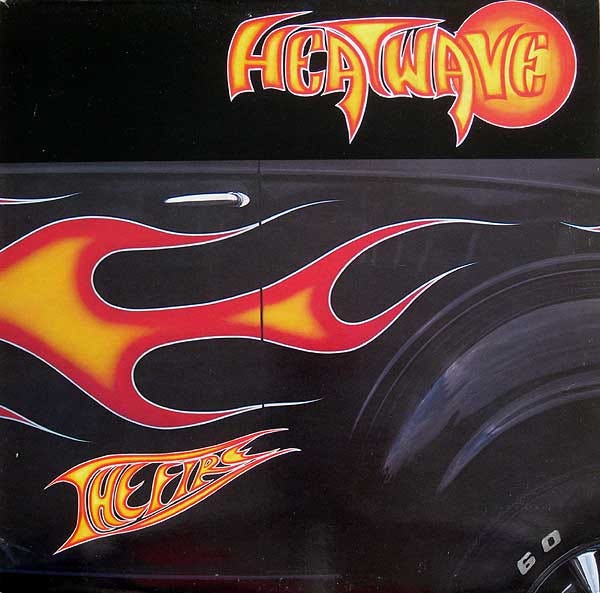
The Fire (1988) – After several years of inactivity as a recording group, Heatwave was revived by Keith Wilder in the late 1980s with an all-new lineup (Keith being the only original member present). They released The Fire on an independent label in 1988 . This album featured returning guitarist Billy Jones and other new personnel. The Fire did not chart significantly and produced no major hits, marking it as more of a footnote in the band’s catalog. Around the same time, Johnnie Wilder Jr. released a solo gospel album My Goal (1988) and then teamed up with Keith for a gospel/soul project Sound of Soul (1989) . These releases had limited commercial impact but are notable for showing the Wilder brothers’ continued musical collaboration post-Heatwave’s prime.
In addition to these studio albums, Heatwave’s popularity led to a number of compilation albums. Noteworthy among them are Heatwave’s Greatest Hits (Epic Records, 1984), which collected their late ‘70s hit singles, and several later collections such as The Best of Heatwave: Always & Forever (1996) and Heatwave: Gold (2020) . A special mention goes to a 1991 remix single, “Mind Blowing Decisions (’90s Mix),” which briefly returned Heatwave to the UK charts (peaking at No. 65) and capitalized on a revival of interest in their music .
Overall, Heatwave’s discography reflects a trajectory from the heights of the disco era into the evolving R&B landscape of the early 1980s. Their first two albums are often regarded as classics of funk/disco, while later efforts saw diminishing returns as the band grappled with internal challenges and changing musical trends.
Hit Songs and Their Impact
Heatwave’s catalog contains several songs that not only charted well at the time but also left a lasting mark on funk, disco, and R&B music. Here we analyze a few of their major hit songs, their chart performance, and their broader impact:
“Boogie Nights” (1977): This upbeat dance track was Heatwave’s breakout hit and remains their most famous song. With its celebratory lyrics and infectious groove (driven by a bouncy bass line, horn riffs, and a memorable hook), “Boogie Nights” encapsulated the height of the disco craze. It reached No. 2 on both the UK Singles Chart and the U.S. Billboard Hot 100 , and also topped the charts in New Zealand . Certified Platinum in the U.S., the song became a staple of late-70s dance floors . Billboard magazine ranked it among the top dance singles of 1977, and it helped Heatwave gain international fame. The song’s enduring popularity is evident – it has been featured on numerous “Best of Disco” compilations and soundtracks, and its title even lent itself to the name of a 1997 film Boogie Nights about the 1970s era. For Heatwave, “Boogie Nights” established them as transatlantic hitmakers and proved that a multi-ethnic UK-based band could compete with the American R&B giants on the charts.
“Always and Forever” (1977): In contrast to Heatwave’s dance hits, this song is a slow, romantic R&B ballad that showcases the group’s soulful side. Written by Rod Temperton, “Always and Forever” features a tender lead vocal by Johnnie Wilder Jr., who delivered the song with gospel-influenced passion (even ad-libbing as if performing live in the studio) . Upon its single release, the song became a Top 20 hit in the U.S. (peaking at No. 18 on the Hot 100) and was a No. 2 R&B hit in 1978 . In the UK, as part of a double A-side, it reached No. 9 . More significantly, “Always and Forever” has achieved the status of an R&B standard . Throughout the late 1970s and 1980s it was a hugely popular “last dance” at high school proms and a wedding slow-dance favorite, especially in R&B and soul music circles. The song’s enduring appeal led to numerous covers – most notably, soul legend Luther Vandross recorded “Always and Forever” in 1994, earning a Grammy nomination for his rendition . The original Heatwave version remains a staple of quiet-storm radio and is often cited as one of the great love ballads in R&B history, demonstrating Heatwave’s versatility beyond the disco floor.
“The Groove Line” (1978): This track was the lead single from Central Heating and became Heatwave’s third big hit. “The Groove Line” is a driving funk/disco hybrid celebrating the joy of dancing and “riding the groove line.” It features a propulsive beat, funky guitar chanks, and a mix of falsetto and tenor vocals from the Wilder brothers. The song hit No. 7 on the Billboard Hot 100 in July 1978 and No. 3 on the Billboard R&B chart , affirming Heatwave’s strong presence in the U.S. market. In the UK it reached No. 12 . Certified Platinum in the U.S., “The Groove Line” was one of the last major disco-era hits before the genre’s backlash later in 1979 . Its enduring legacy is as a classic party anthem – the track frequently appears on funk and disco compilation albums, and its catchy refrain “Come on and groove on the groove line” remains instantly recognizable to fans of 70s music. Along with “Boogie Nights,” “The Groove Line” solidified Heatwave’s reputation for crafting irresistible dance tracks and is often cited when discussing the best funk-disco crossover songs.
“Mind Blowing Decisions” (1978): Originally the B-side to “The Groove Line,” this song gained a life of its own, especially in the UK where it was later promoted as a double A-side. “Mind Blowing Decisions” is a smooth, mid-tempo soul track with lush harmonies and a reflective mood; it deals with the internal debate of a man deciding whether to stay or stray in a relationship. The track’s gentle, hypnotic groove and spoken monologue section made it a favorite on R&B radio. It reached No. 12 on the UK Singles Chart in 1978 . Though not released as an A-side in the U.S. at the time, it became a cult favorite and was remixed and re-released in 1990, charting in the UK during the nostalgia for 70s soul . “Mind Blowing Decisions” showcased Heatwave’s vocal harmony strength and added depth to their hit repertoire beyond the obvious singles.
“Gangsters of the Groove” (1980): By 1980, the disco craze had waned, but Heatwave managed to score a late-period hit with this funk track from the Candles album. “Gangsters of the Groove” has a punchy, synth-funk vibe apt for the emerging post-disco R&B scene. It became a Top 20 hit in the UK (No. 19) in early 1981 , and reached No. 21 on the U.S. R&B chart . The song’s performance was hampered in the U.S. pop market by the prevailing anti-disco sentiment (it did not break into the Hot 100) . Nevertheless, it gave Heatwave one last taste of chart action and demonstrated their ability to adapt their sound. The track’s minor success hinted at the electro-funk direction R&B would take in the early 1980s.
In summary, Heatwave’s major hits like “Boogie Nights,” “Always and Forever,” and “The Groove Line” not only brought them chart success and awards (several Gold/Platinum records), but also left an imprint on their genres. “Boogie Nights” and “The Groove Line” remain definitive disco/funk tracks, often featured in retrospectives of the era, while “Always and Forever” endures as a timeless R&B love song. These songs illustrate the dual impact of Heatwave’s music – fueling lively dance parties on one hand, and touching hearts with soulful balladry on the other.
Influence on Funk, Disco, and R&B
Heatwave’s influence on popular music, especially in the realms of funk, disco, and R&B, is significant considering the relatively short span of their peak years. A few key aspects of their influence are:
Blending Funk and Disco: Heatwave was adept at marrying the syncopated rhythms and bass-driven grooves of funk with the glossy production and four-on-the-floor beat of disco. Tracks like “Boogie Nights” and “The Groove Line” exemplify this fusion. They brought a tight funk musicianship (partly a credit to their international lineup of skilled players) to the disco genre, which influenced contemporaries and successors alike. Many UK and European funk-disco acts that followed, such as Light of the World, Imagination, and Central Line, can be seen as walking in Heatwave’s footsteps, combining slick dance beats with live-band funk elements. In the U.S., Heatwave’s success alongside American bands suggested that disco could accommodate more complex funk arrangements. Their song “Boogie Nights” in particular, with its swing-jazz intro and funky breakdown, showed a creative range that other artists sought to emulate.
Songwriting and the Rod Temperton Effect: Perhaps Heatwave’s most far-reaching influence came via Rod Temperton’s songwriting. Temperton used Heatwave as an early vehicle for his sophisticated compositions, which often included jazzy chord changes and memorable melodies uncommon in standard disco. The fact that Temperton went on to write for mega-stars like Michael Jackson, George Benson, and Donna Summer means that a piece of Heatwave’s musical DNA is embedded in those artists’ hits as well. For example, the smooth funk vibe of Michael Jackson’s “Rock With You” and the suave groove of George Benson’s “Give Me the Night” (both Temperton songs) echo the polished funk-soul blend Temperton honed with Heatwave. In interviews, Quincy Jones praised Temperton’s ability to write melodic R&B that appealed across audiences – a skill first displayed in Heatwave tunes . Thus, Heatwave indirectly influenced the direction of late-70s and early-80s R&B through Temperton’s pen, contributing to the rise of post-disco boogie and the lush urban contemporary sound of the early 80s.
Balladry and Quiet Storm: “Always and Forever” was one of the early big hits in the Quiet Storm R&B radio format (slow, romantic, bedroom-oriented songs). Its success proved that an act known for up-tempo disco could also score with a sentimental ballad. This encouraged many funk/disco bands to include at least one strong ballad on their albums. In the late ’70s, bands like Earth, Wind & Fire and Con Funk Shun similarly had hit slow jams alongside dance tunes. Heatwave’s approach of balancing energy with emotion influenced the repertoire strategy of R&B groups going forward. Additionally, the enduring popularity of “Always and Forever” (with later covers like Luther Vandross’s version bringing it to new generations) underscores Heatwave’s influence on the R&B ballad tradition – the song is often cited by artists as a classic template for a romantic soul ballad.
International and Multiracial Representation: Heatwave was noteworthy for being a multinational, multiracial band at a time when many funk and soul groups were either American black ensembles or European white pop bands. Heatwave’s success helped normalize the idea of a diverse group playing black music styles. Their very makeup (black American vocalists, a white British songwriter, a mixed European rhythm section) challenged some industry biases. In fact, as an anecdote, their U.S. record distributor (CBS/Epic) initially avoided putting the band’s photo on album covers out of concern that an obviously multi-ethnic band might face marketing challenges in America . Despite such hurdles, Heatwave’s popularity demonstrated that music transcended racial and national lines – an influential notion in the increasingly global music industry. They paved the way for later international R&B collaborations and showed British audiences that UK-based bands could excel in funk and disco genres (typically dominated by American acts).
Legacy in Funk and Disco Communities: Within the funk and disco enthusiast communities, Heatwave is often revered as a “musician’s disco band” – meaning they get respect for musical chops in a genre sometimes criticized for simplicity. Their tracks have been sampled occasionally by hip-hop and R&B producers looking for rich 70s grooves. And in the UK’s soul scene, Heatwave’s work (especially the Temperton-penned deep cuts like “Til the Fire’s Burned Out” or “Sho’nuff Must Be Luv”) became club favorites. They are name-checked by artists and DJs as influences; for example, the Brit-Funk movement of the early ’80s cited Heatwave as pioneers bridging American funk with UK flavor.
In summary, Heatwave influenced the sound of late-70s dance music by proving funk and disco could be a sophisticated blend. Through Rod Temperton’s extensive songwriting contributions to others, they indirectly shaped a chunk of pop and R&B history in the 1980s. And their hit ballad broadened the accepted repertoire of dance bands, while their very existence as a successful international band widened representation in the genre.
Collaborations and Connections with Other Major Artists
Throughout their career and afterward, Heatwave and its members have been linked to numerous prominent figures in the music industry. Some notable collaborations and connections include:
Rod Temperton & Quincy Jones/Michael Jackson: The most famous connection is through Rod Temperton’s post-Heatwave career. After leaving the band’s lineup, Temperton was recruited by producer Quincy Jones to write songs for Michael Jackson’s solo albums on Epic Records. This collaboration produced legendary results – Temperton wrote “Rock with You,” “Off The Wall,” and “Burn This Disco Out” for Jackson’s Off the Wall (1979) and “Thriller,” “Baby Be Mine,” and “The Lady in My Life” for Thriller (1982), among other tracks . In doing so, Temperton (and by extension, the Heatwave songwriting style) became a key ingredient in two of the most acclaimed pop albums ever. Temperton also wrote for George Benson (the hit “Give Me the Night”), James Ingram & Michael McDonald (“Yah Mo B There”), Donna Summer, Herbie Hancock, The Brothers Johnson (“Stomp!”), and Rufus & Chaka Khan (“Live in Me”) – all high-profile collaborations that sprang from connections he made after Heatwave’s initial success. Quincy Jones continued to value Temperton’s contributions on many of his projects, underscoring how a core member of Heatwave became a behind-the-scenes collaborator with music royalty.
J.D. Nicholas & The Commodores: As mentioned, James “J.D.” Nicholas left Heatwave around 1982 and joined the American soul-funk group Commodores. He stepped into a challenging role, effectively taking over lead vocals after Lionel Richie’s departure. Nicholas’s Commodores tenure included the mid-1980s hits “Nightshift” and “Animal Instinct.” This connection is notable because it links Heatwave to one of Motown’s biggest funk bands. Through J.D. Nicholas, Heatwave had a direct influence on the Commodores’ sound in the post-Lionel Richie era (his vocal style can be heard on the Grammy-winning single “Nightshift”). It’s a testament to the caliber of Heatwave’s singers that a member went on to front another famous band.
Derek Bramble & David Bowie: After leaving Heatwave, bassist Derek Bramble found success as a producer and songwriter. One of his prominent collaborations was working with David Bowie – Bramble co-produced and played on Bowie’s 1984 album Tonight. This is a surprising cross-genre connection (from funk band to rock legend) and illustrates the versatility of Heatwave alumni. Bramble also worked with UK R&B singer Jaki Graham, producing her hits in the mid-80s . While not a direct “collaboration” with Heatwave as a band, Bramble’s production career is a noteworthy link to other major artists.
Barry Blue (Producer): Heatwave’s producer for their first two albums, Barry Blue, was a former glam-rock artist turned songwriter/producer. Blue’s collaboration with Heatwave was fruitful, and he also co-wrote some album tracks. While Barry Blue himself wasn’t a major artist in the way Quincy Jones or Michael Jackson were, his role connecting Heatwave to the UK music industry was significant. Blue had also produced songs for artists like Diana Ross (he was involved in a project featuring Ross’s backing singers) , which indirectly tied Heatwave’s sound to other projects of that era. Additionally, Phil Ramone producing Hot Property connected Heatwave to one of the industry’s top studio figures (Ramone worked with Billy Joel, Paul Simon, etc.), giving them a bit of crossover into the broader pop production world.
Lynsey de Paul: The British singer-songwriter Lynsey de Paul contributed the song “All I Am” to Heatwave’s Candles album at Johnnie Wilder’s request. De Paul was a well-known UK artist in the 1970s (“Sugar Me” was a hit) and writing for Heatwave showed the band’s openness to outside collaboration even at their peak. It’s a lesser-known connection, but it indicates Heatwave’s network extended into the British pop songwriting community.
Covers by Other Artists: While not collaborations in the traditional sense, the fact that Heatwave’s songs have been covered by major artists is a form of musical connection. The most notable example is Luther Vandross’s cover of “Always and Forever,” which tied Heatwave’s legacy to Vandross’s Grammy-nominated work in 1994 . R&B group Whistle also covered “Always and Forever” (1989) and scored an R&B hit. These covers connect Heatwave’s material to the 80s and 90s R&B scene. Additionally, in 1988, Tatjana (a Dutch vocalist) had a European dance hit covering “Aweso (Boogie Nights)” with reworked lyrics, which shows the song’s influence reaching into the late 80s club scene. Each time their songs were reinterpreted by others, it reinforced Heatwave’s links across the industry.
In essence, while Heatwave as a band mostly worked within their own unit, the members and their music had extensive connections outward. From Rod Temperton’s songwriting that plugged them into Michael Jackson’s orbit, to band members joining other famed groups, to their songs being performed by R&B royalty, Heatwave’s influence and collaborative reach extended far beyond their original incarnation. These connections highlight how respected Heatwave’s talent was among their peers and successors.
Later Years, Legacy, and Post-Peak Events
By the early 1980s, Heatwave’s commercial peak had passed, but the band’s story continued with reunions and the later lives of its members. Here we discuss what happened after their initial success and their lasting legacy:
Break-up and Hiatus: After the Current album in 1982, Heatwave essentially disbanded or went on hiatus. Multiple factors contributed: the band had endured two devastating incidents (Mario Mantese’s stabbing and Johnnie Wilder’s paralysis), key songwriter Rod Temperton was no longer in the group, and musical tastes were shifting in the post-disco era. Keith Wilder and Roy Carter made an attempt around 1986 to launch a new Heatwave tour (even enlisting musicians from the UK funk band Central Line) to play U.S. Air Force bases , but this effort never fully materialized. For several years, Heatwave was largely silent as a recording act.
1988 Reunion – The Fire: In 1988, Keith Wilder revived Heatwave in the studio, assembling a new lineup to record the album The Fire. This version of the band included Billy Jones (returning guitarist from the late ’70s lineup) and other new members, but notably not Johnnie Wilder Jr., who by then was focusing on gospel music (though he gave his blessing). The Fire and its singles (“Straight from the Heart,” “Who Dat?”) failed to chart, and the album received little attention . Meanwhile, Johnnie Wilder that year released his own solo inspirational album My Goal, and in 1989 the Wilder brothers briefly reunited creatively to record a gospel album Sound of Soul (with Johnnie’s a cappella vocal style) . These projects were more labors of love than commercial endeavors, but they kept the Heatwave spirit alive. None of these late-80s releases sold notably, marking the end of Heatwave’s recording career.
1990s Revival and Touring: In the 1990s, Heatwave gained a bit of renewed visibility. The 1991 remix of “Mind Blowing Decisions” brought their name back to the UK charts (albeit briefly) . Around that time, Keith Wilder once again reformed a touring version of Heatwave, primarily to play on the oldies and nostalgia circuit. By the mid-90s, Heatwave (with Keith at the helm, and sometimes featuring original drummer Ernest “Bilbo” Berger) toured in the U.S. and UK, performing their classic hits to fans who remembered the disco days . A live album was recorded at the Greek Theater in Los Angeles in 1997 capturing one such performance . While Johnnie did not perform with these lineups due to his paralysis, he remained a behind-the-scenes co-producer and advisor until his passing. Heatwave’s 90s live incarnations demonstrated the lingering demand for their music and gave younger audiences a chance to see at least part of the band in action.
Deaths of Key Members: As time went on, Heatwave’s members began to pass away, marking the end of various chapters of the band’s legacy. Johnnie Wilder Jr. died in his sleep on May 13, 2006 in Dayton, Ohio . Fans mourned the loss of the voice that had given life to “Always and Forever” – many tributes noted his courage in continuing to create music after his accident. A decade later, the music world lost Rod Temperton, who died in London in 2016 after a brief battle with cancer . Temperton’s death was major news, given his contributions to Michael Jackson’s oeuvre; obituaries universally mentioned that he got his start writing “Boogie Nights” for Heatwave. The following year, on October 29, 2017, Keith Wilder passed away at age 65 . With Keith’s death, Heatwave lost its last active performing member from the classic era. In 2024, drummer Ernest “Bilbo” Berger also died (age 73) of a heart attack , leaving bassist Mario Mantese as the only surviving original member. Each of these passings was met with fond remembrances from fans and fellow musicians, underlining the impact Heatwave had.
Legacy and Recognition: Heatwave’s legacy rests primarily on their music from 1976–1980, which continues to receive acclaim. Their songs are staples on retro radio stations and at 70s-themed events. “Always and Forever” in particular has a life of its own – often ranked among the top R&B love songs of all time by publications and DJs, and still a go-to wedding song. “Boogie Nights” remains synonymous with the disco era; its inclusion in film/TV soundtracks and myriad compilations has kept it in the public ear. In the UK, Heatwave is remembered as part of the country’s musical fabric of the 70s – they appear in documentaries about disco and soul in Britain, often celebrated as one of the few truly international British-based bands to conquer U.S. charts until that point. The band received a measure of formal recognition when they were inducted into the National Rhythm & Blues Hall of Fame in 2017 (shortly before Keith Wilder’s death), honoring their contributions to R&B music.
Perhaps Heatwave’s greatest legacy is how their work continues to influence artists and delight new listeners. Contemporary R&B and funk musicians occasionally cite Heatwave as an influence, especially praising Johnnie Wilder’s vocal ability or Rod Temperton’s songwriting. For example, R&B singer Keith Sweat once listed “Always and Forever” as a song that shaped his approach to ballad singing. Modern funk revival bands have covered “Boogie Nights” in concert to pay homage to the 70s groove. Moreover, each time a Rod Temperton-penned Michael Jackson song plays, there’s a piece of Heatwave’s legacy in it – a reminder that the man behind those hits cut his teeth with a band of guys from America, Britain, Switzerland, Czechoslovakia, and Jamaica, all united by music.
In the end, Heatwave’s story is one of remarkable highs and tragic lows, but through it all, their music endures. They overcame multiple adversities (even earning the nickname “the band that wouldn’t die” in one retrospective account ) and left behind songs that are indeed “Always and Forever” in the hearts of fans. From the dancefloor to the slow dance, Heatwave’s contributions to funk, disco, and R&B remain vital and celebrated.
Notable Anecdotes and Lesser-Known Facts
Beyond the main narrative, a few interesting tidbits and lesser-known facts about Heatwave deserve mention:
Album Cover Controversy: When Too Hot to Handle was released in the U.S., CBS/Epic Records decided not to feature the band’s photo on the album cover, replacing the original UK artwork with a cartoonish image of a melting vinyl record . The label was reportedly concerned that showing Heatwave’s multi-racial lineup might alienate certain segments of the U.S. market (“sociological factors” was the euphemism used) . In Europe, however, such concerns were not present. This incident highlights the social climate of the 1970s and how Heatwave quietly helped challenge it. (Ironically, by their second album Central Heating, the U.S. cover did prominently feature the band’s name in a fiery logo but again not the members’ faces.)
Name Origins: The band’s name “Heatwave” predates the famous 1980s music festival of the same name. It was chosen for its evocation of warmth and energy, but the early moniker “Johnnie Wilder’s Chicago Heatwave” came about because of guitarist Jesse Whitten’s hometown of Chicago . After Whitten’s untimely death in 1976 (he was tragically stabbed and killed in Chicago while visiting home) , the band dropped “Chicago” from the name and continued simply as Heatwave. It’s a bittersweet footnote that the name which implies hot fun also carries a memory of their first guitarist.
Stage Acrobatics: During their late-70s heyday, Heatwave was known for energetic live shows. Keith and Johnnie Wilder, in particular, brought choreographed dance moves to the stage – Johnnie would sometimes do splits or synchronized steps, belying his stocky build, and Keith was equally lively. A 1978 concert photo even shows members performing acrobatic jumps on stage in the USA . This high-energy stage presence made their concerts memorable. After Johnnie’s paralysis in 1979, the live choreography element diminished (as noted, J.D. Nicholas wasn’t the dancer Johnnie was) , marking the end of an era where Heatwave shows were as much visual spectacles as musical ones.
“Keep Tomorrow for Me” – Lost Song: In 1979, Heatwave recorded a song called “Keep Tomorrow for Me” for the soundtrack of the action-comedy film Escape to Athena. Composed by Barry Blue with lyrics by Rod Temperton, it was used over the film’s end credits . Many fans consider it a hidden gem in Heatwave’s catalog, blending disco and cinematic orchestration. However, due to the film performing poorly and rights issues, the soundtrack was never widely released (except in Japan), so the song remained obscure . It’s a curious piece of Heatwave trivia that they have a great song locked away by a movie studio – a track some enthusiasts only discovered years later via rare vinyl or bootlegs.
Mario’s Miraculous Recovery: Mario Mantese’s survival and recovery from his 1978 stabbing incident borders on the miraculous. After being blinded, mute, and paralyzed, he not only regained his sight and speech but eventually wrote multiple books and became a spiritual teacher/guru in Switzerland . One of his books, Heart Beat, discusses his near-death experience. It’s highly unusual for a pop band’s bass player to later become a mystic author, making Mario’s journey a fascinating post-script to Heatwave’s story. His forgiveness of the girlfriend who stabbed him – he even lived with her again after hospital release – is another startling aspect. Mario’s life story has been covered in European media, separate from Heatwave’s music, illustrating the human dramas that unfolded behind the scenes of the band.
Cultural Appearances: Heatwave’s music has popped up in various cultural settings. For example, “Boogie Nights” has been featured in video games like Grand Theft Auto: Vice City Stories (bringing their funk to a new generation of gamers) and in numerous films set in the 70s. The title “Boogie Nights” was used for Paul Thomas Anderson’s acclaimed film, and though the song itself isn’t the theme of that movie, it does appear on the soundtrack – cementing the association of the song with the era’s hedonistic vibe. “Always and Forever,” on the other hand, has practically become an R&B anthem – it’s often performed on talent shows, covered by artists in tribute concerts (for instance, it was sung at Luther Vandross’s funeral, since he had made it one of his staples). Such appearances underscore how Heatwave’s songs have woven into the fabric of pop culture.
Chart Oddities: Heatwave experienced some interesting chart quirks. Their single “Gangsters of the Groove” in 1981 famously stalled at #110 on the Billboard charts – technically not making the Hot 100, but appearing on the “Bubbling Under” chart . This was a victim of timing, coming during the backlash against disco. Conversely, in the UK, a double A-side release of “Always and Forever”/“Mind Blowing Decisions” meant both songs became hits even a year after the album – something relatively uncommon but showing Heatwave’s continued popularity in Britain in late 1978 . Additionally, Heatwave’s albums generally did better on R&B charts than pop charts, reflecting how they maintained a strong soul audience even when crossover success waned.
In closing, Heatwave’s career is filled with notable moments, both triumphant and tragic. They left behind more than just music; they have stories of perseverance, cross-cultural unity, and the unpredictable turns of fate. From a record label’s cautious marketing decisions to miraculous personal recoveries, these anecdotes add depth to the band’s legacy. Heatwave will be remembered not only for making people dance and fall in love with their songs, but also for the remarkable narrative of the band itself – truly a “Heatwave” of talent, adversity, and enduring influence.
Thank you for this